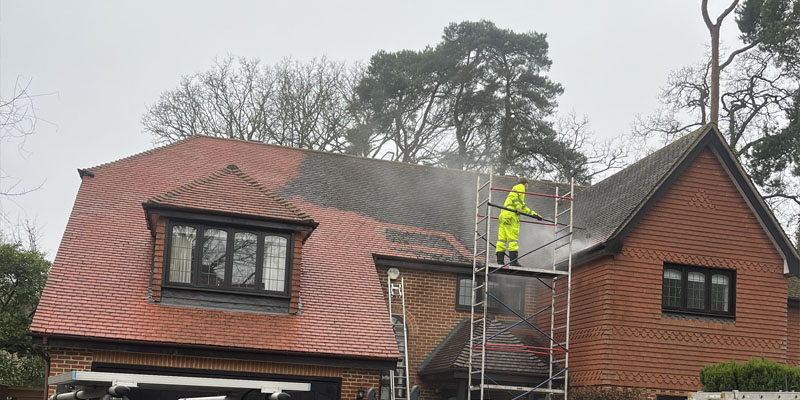
Professional Roof Cleaning Services

Residential and commercial roof cleaning is an essential maintenance service that delivers long-term benefits for any property. Regular roof cleaning is a proactive measure that helps protect the structure from damage, preventing minor issues from developing into costly repairs.

Moss is an invasive, non-flowering plant that commonly forms on roofs when airborne tree spores settle on tile surfaces. Thriving in damp, shaded conditions, moss exploits even the smallest cracks and imperfections. As it spreads, it develops root-like structures that penetrate the tile surface, gradually lifting tiles, retaining moisture, and accelerating roof deterioration.

020 3355 2138

Dealing with Moss

As moss establishes itself on a roof, its root-like structures can crack and weaken tiles over time. Moss also acts like a sponge, absorbing and retaining large amounts of water, which keeps the roof surface constantly wet. This prolonged moisture can lead to rot within the roof deck and deterioration of the underlayment beneath the tiles.

During winter months, retained moisture within the moss freezes and expands. When moss is growing between tiles, this expansion can force tiles apart, dislodging them and increasing the risk of water ingress.

Moss growth also creates an ideal environment for further contamination. Wind-blown seeds readily settle into the moss, and pigeons in particular are attracted to it, pecking at the surface. This activity results in the accumulation of bird guano, which—under HSE guidance—is classified as hazardous to contractors working on the roof. Falling debris and droppings can also pose a risk to residents below. In addition, guano provides a nutrient-rich base for further organic growth, eventually allowing weeds to establish on the roof surface.

As moss becomes loose, it can roll down the roof and collect in gutters, preventing them from functioning correctly. If downpipes become blocked, rainwater will overflow at the lowest point of the guttering. This concentrated flow of water running down external walls can, on average, lead to internal damp issues within as little as six months.

Commercial Roof Cleaning

For commercial properties, the gutter and gulley issues outlined above are particularly prevalent due to larger roof areas and higher volumes of water run-off. Where roofs are finished with rubber membranes—such as those commonly found on warehouses—organic build-up can create extremely slippery surfaces. In many cases, roofing contractors will decline to carry out repairs until the roof has been professionally cleaned, as the conditions present a significant safety risk.

Poor or irregular roof maintenance is a common cause of internal leaks across commercial buildings. Warehouses, hotels, and other large or tall structures frequently suffer water ingress not because of defective materials, but due to blocked drainage, retained moisture, and surface contamination that has been allowed to build up over time.

We have extensive experience carrying out roof cleaning works on a wide range of commercial properties, including:

REQUEST A QUOTE

Types of Roof

Roof cleaning can be divided into two distinct categories, with every project beginning with a detailed survey visit. This allows us to assess the condition, age, and construction of the roof and determine the most appropriate and safest cleaning method.

Newer roofs (1970s – present)

For modern roofs that are in good condition, we recommend steam cleaning. Using specialist DOFF equipment, we keep pressure to an absolute minimum and allow high temperatures to do the work instead. This method is highly effective at removing moss, lichen, and general atmospheric dirt that can discolour a roof from its original appearance.

Once the steam clean is complete, we apply a BAC50 Pro biocide treatment, either sprayed or brushed into the surface. This treatment penetrates deep into the tiles and inhibits organic regrowth for up to 10 years or more. This method is widely regarded as safe by building surveyors and architects.

Older roofs (Victorian – 1960s)

For older or more fragile roofs, we prefer a careful manual approach. Moss and lichen are removed by hand using specialist brushes or blades. While this method is more time-consuming, it is the most effective way to protect loose, cracked, or weathered tiles that could be damaged by other cleaning techniques.

Working safely from roofing ladders, our trained operatives remain close to the surface, allowing them to identify potential issues—such as damaged tiles or failing fixings—before they develop into more serious problems. Although this method does not remove ingrained dirt, it achieves a controlled and careful removal of moss and lichen. A BAC50 Pro biocide treatment is then applied to prevent regrowth.

Final checks and clean-up

Following all roof cleaning works, we clear the gutters, check downpipes for blockages, and ensure the property is left clean, tidy, and fully presentable.

Important Note: There is a lot of misinformation in the public domain regarding roof shingle (a protective sand coating which is pre installed onto the tile from the factory). It is a common misconception that washing a roof will remove this shingle from the tiles. However, as per the tile manufacturers own guidelines, roof shingle is only designed to stay for the first 15-30 years of a tile’s lifespan.

Our assessor will always ascertain the build/roof date of the building and if it is older than 30 years it is highly likely that there is no shingle left. Only with some specialist designer tiles will the shingle last for 50 years and after this age the shingle is totally gone and the tile is then left to the elements. The average lifespan for a concrete tile is 50-60 years, (30 of those years without shingle), a clay roof will last for 60-100 years, only the first 15-30 have shingle intact, after that rain and wind erosion will naturally remove this shingle.

A roof should only ever be accessed and worked on by a trained professional. It should not be indiscriminately jet washed with cold water by an inexperienced operator, as this approach presents a serious risk of injury to people, damage to the roof, and harm to others below.

Careful control of water pressure is essential. Excessive pressure—typically in the region of 150–200 bar—combined with improper access methods, such as walking directly on the roof without roofing ladders or safety systems, greatly increases the likelihood of tiles being cracked, dislodged, or broken underfoot. High-pressure water can also lift tiles, strip protective surface coatings, and force water beneath the roof covering, leading to hidden water ingress and long-term damage.

Unfortunately, once problems become apparent, the damage has often already been done. This is why property owners must take care when selecting a roof cleaning contractor. By the time defects or leaks are noticed, an unqualified operator is often long gone, having already taken payment on the day and leaving the customer to deal with costly repairs.

The common different types of roof tile:

020 3355 2138